
Battery storage in Ukraine: investing in power-system flexibility
Battery energy storage: managing delivery timing, power and consumption as the foundation of a commercial model.
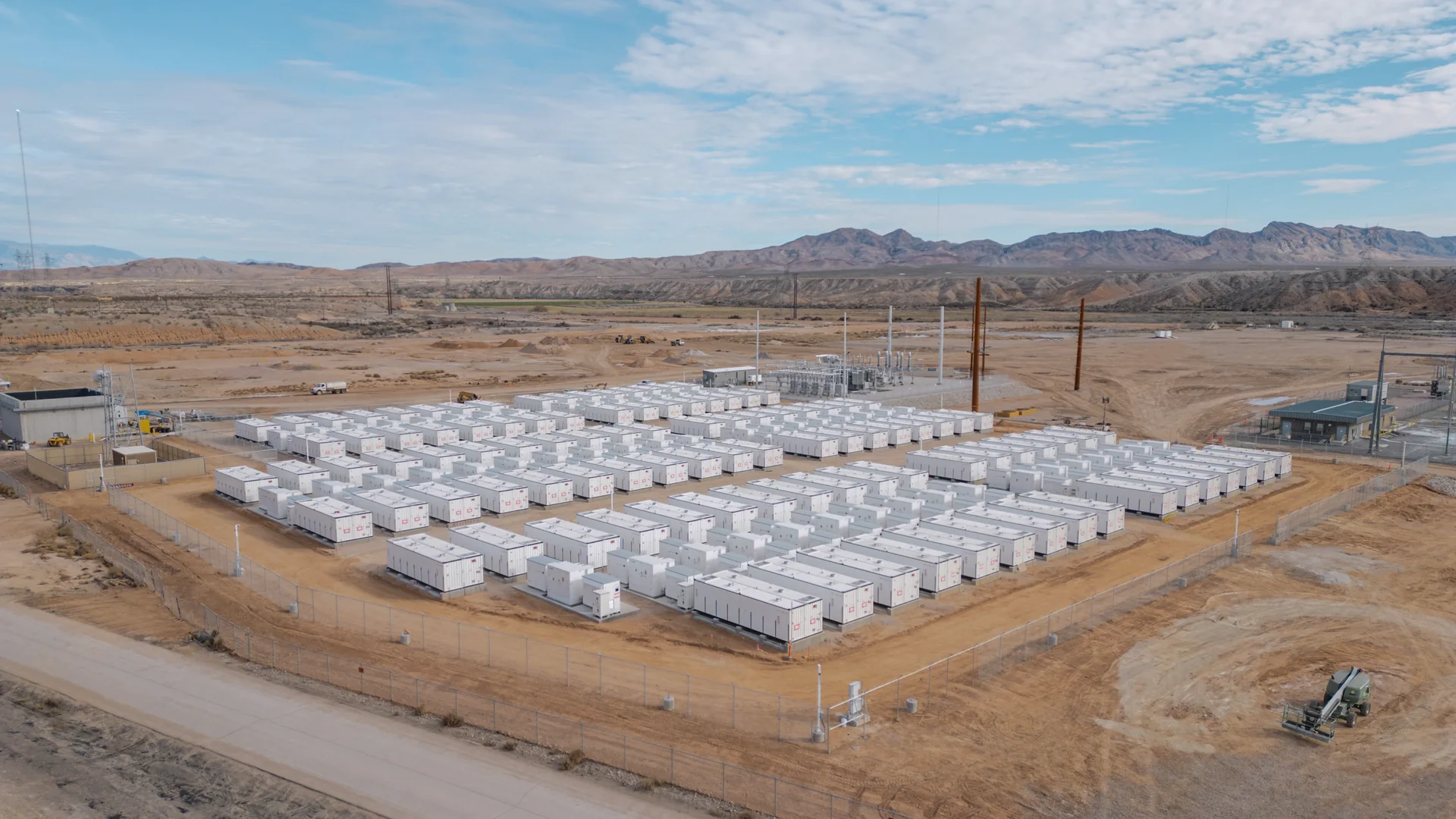
Explore projects in the catalogueReid Gardner BESS, Nevada, USA — an international technology example. Photo: Sig. Chiocciola · CC0 1.0

Jurisdiction: Ukraine. Sources reviewed . Periodic review required. Next scheduled editorial review: . Material rule changes require earlier review.
Treat storage as a constrained delivery system
A BESS investment starts with usable MW/MWh, separate grid import/export and a feasible revenue schedule. Battery capacity alone does not establish market qualification, an award, a contracted return or sufficient funding for the operating life.
From demonstrations to larger systems
On 11 September 2025, DTEK announced the energisation of a 200 MW / 400 MWh storage project with Fluence. This is the operator’s account of its own project, not an independent assessment of investment performance. DTEK announcement.
Tillerstone’s view: assess storage against a defined function — shifting energy between hours, managing peaks or providing system services where the relevant conditions are met. Potential revenues must be reconciled with feasible operating modes, without counting the same capacity twice.
Two essential ratings and the full lifecycle
MW describes charging or discharge power; MWh describes the quantity of energy. Their ratio helps indicate nominal duration, but actual performance depends on permitted discharge depth, losses and technical constraints.
- Confirm the connection, import and export modes, and control requirements.
- Review manufacturer warranties, degradation, permitted cycling and service terms.
- Include fire safety, insurance and potential augmentation in the budget.
- Test the economics under different prices, workloads and availability assumptions.
A prepared project explains how the battery will operate each day and who will be accountable for delivery.
Start with the function the investor will fund
Describe power in MW, energy capacity in MWh, the grid position and the intended operating model. Tillerstone helps turn those inputs into a clear Project Passport, separate evidenced facts from assumptions and prepare a conversation about capital or a sale.
Battery opportunity outline
Table — scroll horizontally if needed
| Item | Evidence / definition | Screening consequence |
|---|---|---|
| Capacity | Nominal and usable energy, power and duration at stated boundaries | Comparable equipment and service capability |
| Grid | Requested, offered, contracted and usable directional capacity | Feasible charging and discharge |
| Revenue | Trading route, qualification and actual contract status | Separate income evidence from potential |
| Dispatch | State of charge, reserves, cycling, losses and outages | Prevent double counting |
| Lifecycle | Degradation, warranty throughput and augmentation budget | Fund more than initial equipment |
Find your next project
Explore projects in this technology
Looking for a personal shortlist? Share your investment criteria. Own a project? Submit it for consideration.
Reviewed 11 September 2026. Market examples come from public sources; commercial interpretations are Tillerstone’s editorial view. Mentioning an institution or company does not imply a partnership or that its assets are in the catalogue.
A practical perspective from Tillerstone. General information, not project-specific legal, technical, financial or investment advice.
Continue the conversation
A mandate worth discussing?
Share an initial outline. Keep project identities and confidential documents for the agreed private process.
Discuss your mandate